



























Growing up in Pakistan, I realised very early that the lives of many girls revolve around constraints imposed upon them, to the extent that sometimes even their birth is questioned rather than celebrated. Decisions about their education, career or marriage are made for them – not by them. In this process, many women lose their voice; some learn to be content with very little, but a rare few begin to challenge the norm. I did that.
The more I was denied a leadership role – from medical schools to professional boards – for being a woman with her own opinion and ability to disagree, the more I realised something deeper. Instead of adhering to the common saying, ‘If they do not give you a seat at the table, then bring your own folding chair,’ I began to wonder who was setting the table and why the world was making women adapt to places that were never built for them in the first place. I started asking why women in medicine couldn’t have their own table? While resilience might help one woman earn a seat, mindsets that are unwilling to share decision-making power do not change overnight. This only happens when women unite to make places of their own.
A clear revelation emerged: Pakistan required an organisation for women health professionals. Despite constituting around 70% of medical college admissions, most women drop out of the field or are hardly seen at policy tables. This issue was not about merely personal preferences, but rather about systemic gaps.
Initially, the idea of an organisation was just a thought experiment. As I shared it with others, there was very little positive feedback and huge criticism. Many dismissed it outright, while others blamed us for trying to create gender division in medicine. At one point, only five or six women were willing to support the cause; yet even they were unsure whether they were ready to pay the cost of challenging the status quo.
Then one opportunity changed the entire scenario!
I attended the RCP’s Global Women Leaders Programme in Pakistan on the suggestion of Dr Somia Iqtadar, who knew that we were discussing creating a women health professionals’ association.
This programme, held on 2–4 May 2023, became a turning point that gradually changed the narrative and opened up avenues that we thought were forever closed to us. For the very first time during this journey, which was quite draining at times, I was in a position to interact with intelligent and motivated women who understood where I was coming from – as a woman trying to create her own path in life – without having to explain my struggles.
This programme was geared towards empowering women leaders in the field of healthcare – through areas such as leadership and influencing skills, gender-based biases, teamwork, systemic change, time management and networking. The facilitators consisted of RCP faculty members Professor Mumtaz Patel, David Parry and Rebecca Selman; their skills were exemplary and they left an impact on us through personal stories and shared how success can never be smooth sailing. The leadership training also offered psychological safety for women to express themselves and reflect on their experiences and circumstances, which in turn helped attendees to overcome the unique challenges they faced and supported their personal growth.
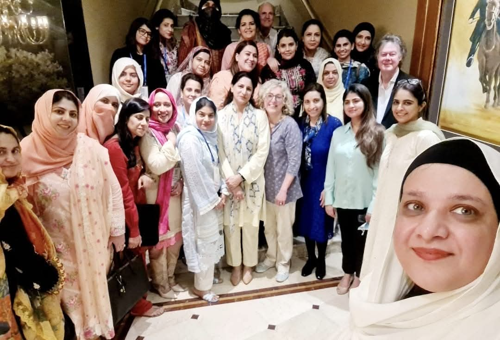
Image: RCP’s Global Women Leaders Programme cohort
Another major lesson that the programme imparted was the realisation that the leadership gap among women in the healthcare field is not only an issue in Pakistan, but a universal challenge. Women account for more than 70% of the health workforce globally, but constitute merely 25% of all leadership roles in high-income countries and less than 5% in low- and middle-income countries. Furthermore, women are largely underrepresented at senior academic ranks. Such discussions helped me realise that the challenges I had faced throughout my career were just the tip of the iceberg. According to the programme facilitators, the squandering of so many women’s talents negatively affects the health system of the entire planet; the greater involvement of women in leadership would not only help female healthcare professionals, but benefit the whole community through the improvement of health agendas.
The vision of the Medical Women’s Association of Pakistan (MWAP) became very clear in my mind:
A healthcare community that enables women health professionals to thrive as leaders and positive agents of change.
Most people tend to laugh whenever they are presented with new ideas, but when I informed colleagues at the RCP of my vision to form an association of women health professionals, I received several encouraging words – especially from Mumtaz. This meant a lot to me at that time.
The programme also helped to develop valuable networks; eight of the 33 founding members of MWAP (Dr Mahwish Arooj, Dr Saima Chaudry, Dr Nazish Imran, Dr Nabila Talat, Dr Lubna Kamani, Dr Noor-i-Kiran, Dr Mehrin Farooq and myself) were part of this leadership development programme. The conversations that began among a few people now had the potential to spark a movement!
Image: Dr Wajiha Rizwan and Dr Mahwish Arooj

Once we knew that the challenges that women encounter in healthcare are universal, we went searching for associations of women health professionals across the world. In the process, we came across the Medical Women’s International Association (MWIA), an association working since 1919, which has consultative status with both the World Health Organization and the United Nations.
We reached out to them with great optimism, but no expectations. To our great surprise and euphoria, we were accepted to form the Medical Women’s Association of Pakistan (MWAP), the Pakistan chapter of the MWIA, on 26 October 2023, after a period of 6 months of continued efforts. We are especially grateful to Dr Beverly Johnson, social media chair, and Dr Eleanor Nawadinobi, then-president, for their continued support and encouragement.
We are now leading globally as Pakistan’s national women’s health professional association. I had the honour to represent Pakistan and MWAP as president at the Central Asia Congress in 2024 and the 33rd MWIA International Congress in 2025, with Dr Shamsa Humayun, our senior vice president.
MWAP is now actively contributing to building health professional capacity in Pakistan, raising awareness about workplace harassment, promoting women leadership development, and advocating for the rights and wellbeing of female health professionals – as well as women and children at national and international levels.
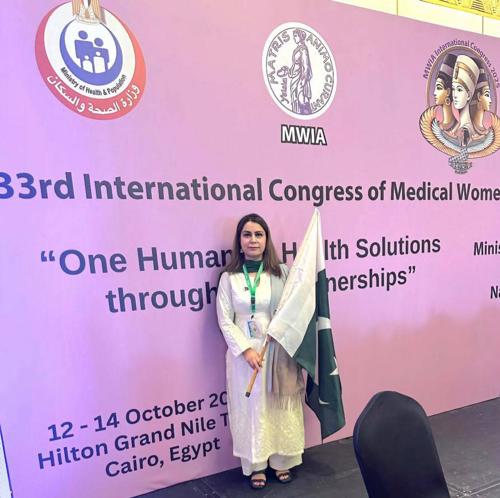
Image: Dr Wajiha Rizwan at the MWIA International Congress in 2025
Looking back as an RCP Global Women Leaders Programme alumnus, all I can say is that while many courses build your CV, very few transform you into a leader who multiplies leadership in others and dares to challenge existing systems. For me, this programme truly accomplished both goals.
The journey continues, the path is challenging, but our determination is strong. At times, women’s leadership is not given the attention or recognition that it deserves. In this context, we remain grateful to the RCP, which continues to be an important part of our journey as Global Women Leader Programme alumni.
We have now expanded our reach and are taking our work to the next level as an independent non-profit organisation, Medical Women’s Foundation Pakistan (MWFP), registered in Pakistan and supported by thousands of volunteers nationwide – including several men. We remain committed to advancing women’s leadership in healthcare and look forward to the RCP’s continued support and collaborative capacity-building initiatives for women; including short observerships and future certification programmes, designed to strengthen skills, mentorship and professional growth.
And last but not least, let’s change the narrative together: ‘If they do not offer you a chair at the table, build your own and lead it like a queen, who makes space for others.’
Beyond the invaluable leadership skills, the RCP Global Women Leaders Programme provided a powerful ecosystem of change-makers. Connecting with the right people through this course is precisely what allowed us to get MWFP off the ground.
Dr Saima Chaudry
Director, MWFP
This was the first formal leadership programme I have attended, and it exceeded all my expectations. In a world where leadership can often feel isolating, this programme created a lasting community of support, encouragement and empowerment.
Dr Mahwish Arooj
Vice president, MWAP
To find out more about the Global Women Leaders Programme, email global@rcp.ac.uk. UK-based physicians can read more about our Emerging Women Leaders Programme on the RCP website.
Dr Wajiha Rizwan
Founding director of the Medical Women's Foundation Pakistan